
Washington D.C.
In a move that has caught both the consumer goods industry and retail markets entirely off guard, the Department of Health and Human Services (HHS) announced a sweeping federal ban on the manufacture and sale of standard synthetic, plastic-bristled toothbrushes.
The emergency directive seeks to eliminate the daily, microscopic shedding of polymers inside the human body. Citing a wave of recent ecotoxicological data and public health assessments detailing how daily oral care routines release massive quantities of microscopic synthetic particles directly into human tissue, the administration is mandating an immediate domestic pivot toward organic, pre-industrial alternatives.
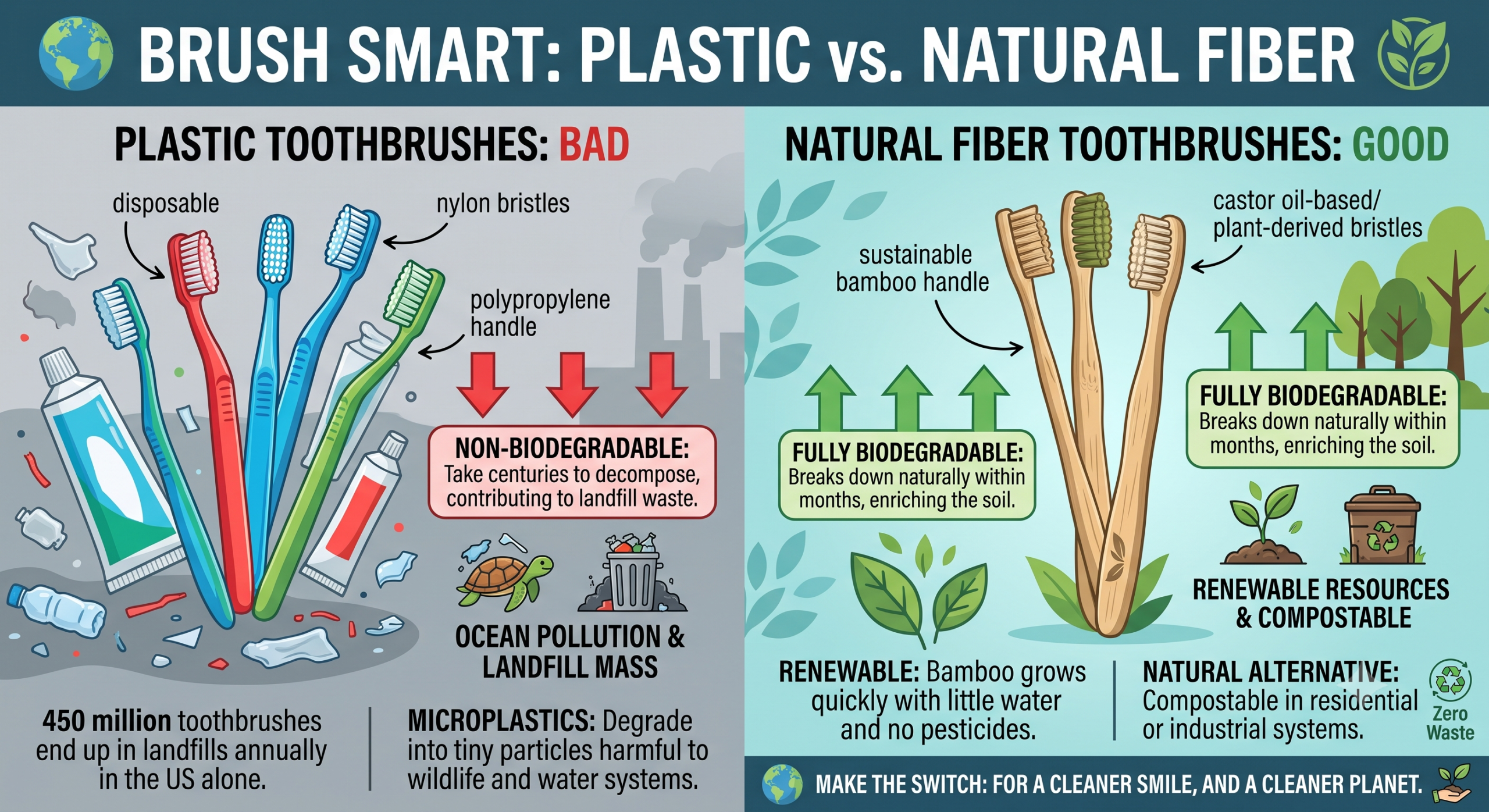
Moving forward, commercial suppliers must transition their production lines to toothbrushes utilizing bamboo handles fitted with natural pig or horse hair bristles.
The Oral Exposure Paradigm
The aggressive regulatory intervention builds on data published in the journal Ecotoxicology and Environmental Safety, which characterized the intense, time-dependent shedding of microplastics (MPs) from popular consumer toothbrushes.
Controlled mechanical simulations tracking the degradation of common synthetic bristles, specifically those manufactured from polyamide (PA), polypropylene (PP), and polyethylene terephthalate (PET), demonstrate that standard brushing motions trigger significant surface wear, fracture propagation, and large-scale fragmentation. Over time, dynamic friction and mechanical stress create burr-like structures and debris along the bristle bodies, continuously sloughing off thousands of synthetic fragments smaller than 100 micrometers directly into the oral cavity.
Public health officials warn that these microscopic particles are uniquely hazardous due to their small size and vast cumulative surface area. Once released into the mouth, the particles can bypass the body’s natural filters, potentially penetrating cellular walls, entering the bloodstream, and migrating via the lymphatic system to accumulate within critical organs such as the brain, liver, and kidneys.
Furthermore, because modern synthetic polymers are frequently formulated with chemical plasticizer additives like bisphenol A, their structural degradation inside the body poses long-term toxicological and endocrine risks that the administration argues require immediate preventative source control.
The Multi-Tiered Mandate
While the baseline regulation represents a complete overhaul of the dental hygiene aisle for the vast majority of consumer demographics, the enforcement strategy introduces a highly distinct fiscal carve-out designed to address economic realities.

Acknowledging that organic, sustainably sourced bamboo and authentic swine-hair toothbrushes carry a significantly higher manufacturing cost than mass-produced polymers, HHS has modified the compliance parameters for vulnerable populations. Under the newly issued rules, low-income households enrolled in federal assistance initiatives, specifically the Supplemental Nutrition Assistance Program (SNAP) and Medicaid, will be explicitly exempt from the synthetic ban.
Eligible individuals will be legally permitted and publicly encouraged to continue purchasing traditional plastic-bristled toothbrushes indefinitely, ensuring that lower-income brackets face no immediate financial disruption or out-of-pocket health-care premiums at the grocery counter.
The Thermodynamic Reality
The public reaction to the dual-tier health mandate has split sharply along ideological and economic lines. Proponents of the policy argue that cutting off the plastic supply line at the source is the only mathematical way to halt the systemic accumulation of synthetic polymer debris within the national population.
“We have spent decades allowing corporate entities to line our mouths with non-degradable polymer chains,” an environmental safety advocate commented during a weekend symposium. “The data shows that synthetic bristles act as a continuous delivery mechanism for micro-fragments. Transitioning to horsehair and bamboo restores a natural equilibrium to primary oral hygiene, neutralizing the risk profile before the bristles even touch the enamel.”
Conversely, corporate retail associations and legal analysts have raised immediate logistical concerns regarding the administrative carve-out, questioning the public health logic of a system that leaves lower-income citizens exposed to the exact same synthetic particles the mandate labels an emergency hazard.
As manufacturing distribution networks adjust to the reality of the domestic bristle divide, the administration remains completely firm. Production facilities across the country have until the end of the quarter to retool their machinery for organic material processing, signaling an end to the era of cheap, synthetic smiles and initiating a bold, rustic transformation of the American morning routine.